See it illustrated
Explore selected illustrations, then open a guide to see the full image and related reading.
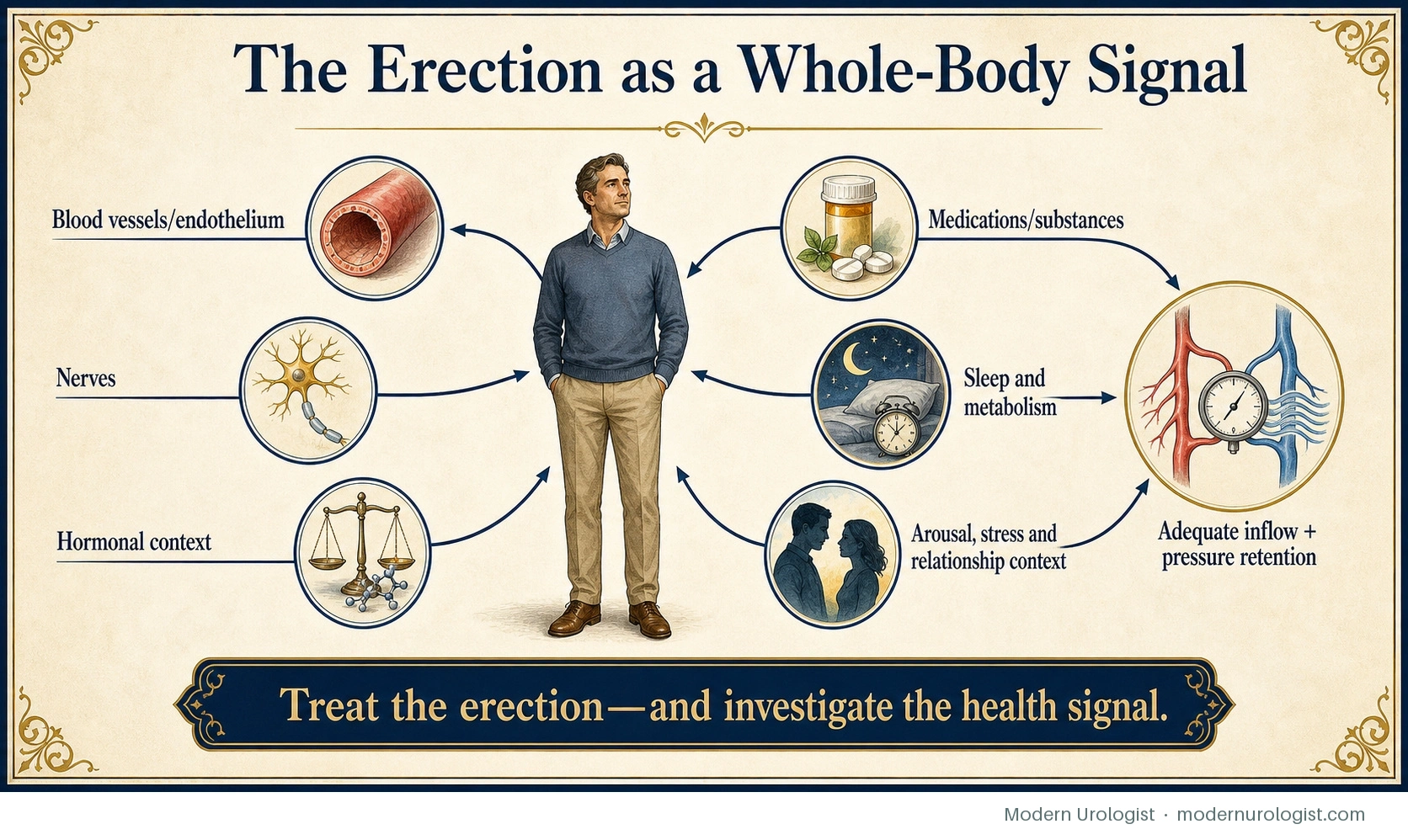
The Erection as a Whole-Body Signal
Open illustrated guide →
Home / Treatments / Penile Implant & Peyronie's Treatment
Explore the illustrated guide ↓
Definitive solutions for erectile dysfunction and penile curvature, when other treatments have not been enough.
For erectile dysfunction that has not responded to medication or other therapies, an inflatable penile implant offers a reliable, long-term solution. The device is placed entirely within the body and is designed to restore natural, on-demand function with a high rate of patient satisfaction.
Peyronie's disease — a curvature of the penis caused by scar tissue — can interfere with function and comfort. Treatment is tailored to the individual: options range from procedures that address the scar-related curvature directly to corrective surgical techniques.
Both conditions are common, treatable, and nothing to be embarrassed about. The right approach depends on the specifics of your situation, which a private, straightforward consultation is designed to work through.
Explore selected illustrations, then open a guide to see the full image and related reading.
Erectile dysfunction and Peyronie's disease are far more common than most men realize — and both are treatable. The consultation is private, direct, and focused on the option that fits your situation.
Book a ConsultationSchedule a consultation and start with a complete diagnostic picture — and a treatment plan built around the smallest effective step.
Book a ConsultationUNDERSTAND YOUR CARE
Penile curvature becomes a treatment question when its cause, timing and effect on sexual function are understood. Pain, narrowing, shortening, erection quality and difficulty with intercourse may matter as much as the angle.

A newly acquired bend is different from a lifelong stable shape. The clinician asks when it began, whether pain or curvature is still evolving, and whether an indentation, hinge effect or loss of length is present. Examination and selected assessment help distinguish Peyronie’s disease from other conditions.
The emotional effect is part of care. Avoiding intimacy, fear of injury and difficulty discussing the change can add burdens that a measurement alone cannot capture. Explain what function you hope to regain. Any clinical photographs should be handled only through an approved secure process after the office explains what is needed; do not email intimate images to an ordinary inbox.
Management considers whether the condition is evolving or stable, the degree and type of deformity, erection quality and patient goals. Observation, selected nonsurgical options and surgery have different roles. Not every person with curvature needs an intervention, and not every treatment is suitable for every deformity.
Surgical choices can involve tradeoffs between straightening, length, sensation and erectile function. An implant may be discussed in selected patients with significant ED as well as deformity. Ask what the proposed treatment can reasonably change, what it cannot restore and what recovery involves. Preserving communication and comfortable intimacy while evaluation proceeds can be valuable; success should be described in functional terms rather than a promise of a perfectly straight or restored penis.
When to seek care: A sudden injury with a popping sensation, major swelling or bruising, or abrupt loss of erection can indicate penile fracture and needs emergency assessment.
Explanation adapted from A Urology Consult in a Book by David Shusterman, MD, chapter 26, “Ejaculation, Orgasm, And Penile Curvature.” Original illustration reproduced from the book. NIDDK: penile curvature.