 INFORMATION FIRST. PRECISION NEXT.
PROSTATE HEALTH
Your questions.
A clearer path.
Explore the illustrated guide ↓
Explore prostate artery embolization (PAE) with a conversation about your symptoms, evaluation, and treatment options.
Discuss your options ↗See it illustrated
Explore selected illustrations, then open a guide to see the full image and related reading.

Prostate Size Is Not the Same as Obstruction
Open illustrated guide →
Matching a Prostate Procedure to the Patient
Open illustrated guide →INFORMED DECISIONS
Start with
the right questions.
Is PAE an option for me?
Your consultation is the place to discuss suitability, alternatives, expected benefits, and risks with the clinical team.
What should I bring?
Bring a list of medications, any available test results, and the questions you would like to discuss.
Where can I learn more?
Read the practice’s existing PAE page for its current treatment information.
UNDERSTAND YOUR CARE
Compare prostate procedures by anatomy, recovery and function
Once obstruction is established, the next question is which treatment fits your anatomy and priorities. Different procedures can relieve an outlet problem through different mechanisms and involve different recovery and sexual-function tradeoffs.
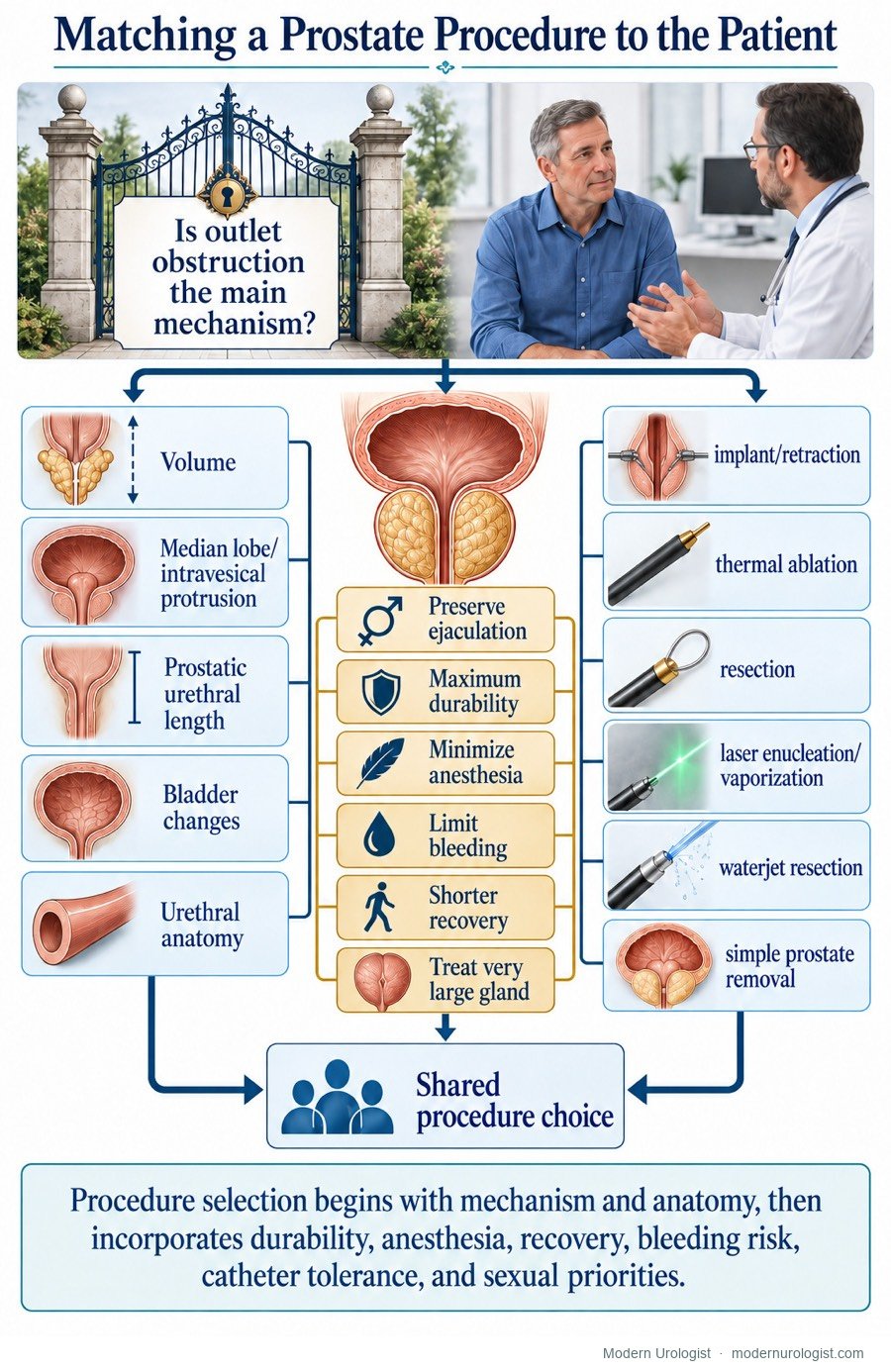
Anatomy helps decide whether an option fits
Prostate volume is only one part of procedure selection. The shape of the gland, a median lobe projecting into the bladder, the prostate channel, urethral anatomy and bladder changes may affect suitability. Ask which examination or imaging finding supports the particular procedure being discussed.
Treatments can hold tissue aside, apply energy, remove or reshape tissue, or reduce its blood supply. They are not interchangeable simply because each is described as minimally invasive. Some are better suited to particular sizes or anatomical patterns. The available evidence, clinician expertise and your health conditions influence the recommendation.
Compare the whole treatment pathway
Discuss anesthesia, bleeding precautions, catheter expectations, short-term urinary symptoms, recovery time, durability and the possibility of another treatment. Preservation of ejaculation may be a high priority for one person; another may prioritize the most durable improvement or the least anesthesia. No single preference should be assumed.
Ask what will happen if the first option does not provide enough benefit. A later procedure may still be possible, but prior treatment can affect planning. Separate the chance of improving urinary obstruction from effects on erections or ejaculation; these are different outcomes. Make sure that medication management, recovery instructions and the timing of follow-up are clear before proceeding. The comparison should describe reasonable alternatives and limits as well as the proposed treatment’s advantages.
Questions to bring to your visit
- Which anatomical finding makes this procedure suitable for me?
- How do the alternatives compare for catheter use, anesthesia, recovery and ejaculation?
- What is the follow-up plan, and what options remain if benefit is incomplete?
When to seek care: Inability to urinate needs emergency assessment. Fever with urinary obstruction, severe worsening pain or new neurologic symptoms also needs urgent care.
Explanation adapted from A Urology Consult in a Book by David Shusterman, MD, chapter 19, “Choosing A Prostate Procedure.” Original illustration reproduced from the book. NIDDK: enlarged prostate.